






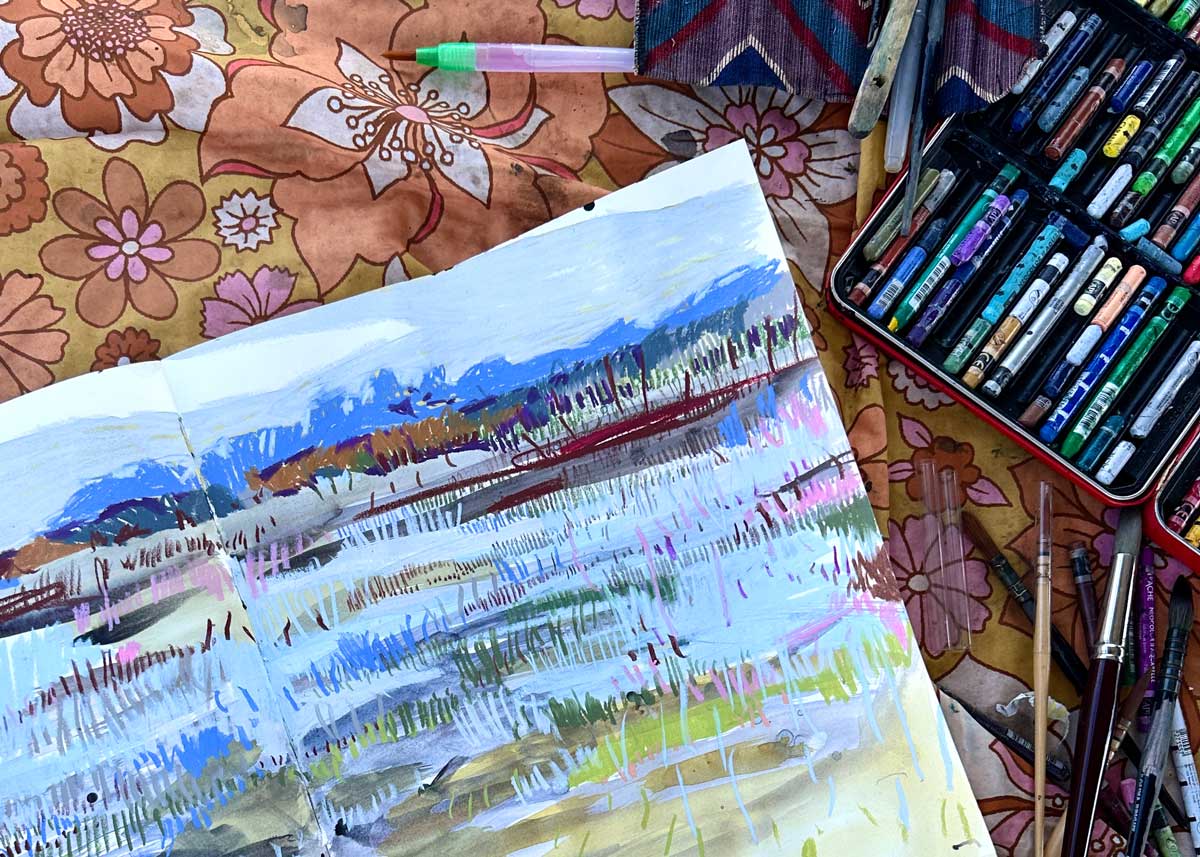

Going from an established studio, with ten years of chaotic creative collecting stored inside it, to a small wheelie toolbox of materials for workshops and a tote bag for my kit was, I’m not going to lie, really challenging.
As we prepared for our trip around Australia, weight was one of our biggest concerns. I couldn’t bring everything. I couldn’t even bring most things. Only the absolute essentials were going to make the cut.
So, after plenty of umming, ahhing and asking myself whether I really needed 20 brushes, I whittled my studio down to a travelling art kit.
Here’s what came with me.
First things first: I’m not really an en plein air painter
I wouldn’t call myself an en plein air painter. I don’t have the fancy easel, tiny stool and pochade box. That style of painting is a bit of a niche of its own.
I do, however, really enjoy painting outside.
My approach is generally a little less sophisticated. I like having all my materials around me, so I tend to sprawl everything out on a picnic blanket on the ground and settle in.
Not quite as easy with my poor old injured ankle these days, but still my preferred method.
And somehow, in one straining, overweight tote bag, I cram the following...

Watercolour paints + folding tin palette
In my studio I had a large plastic palette with a spacious mixing area and wells filled with watercolour paints around the outside edge. Up until this trip, I’d always just popped the lid on and taken the whole thing outside with me. It was far too large, and far too brittle with age, to survive life on the road though. So I bought one of those folding metal tins that allows you to construct your own assortment of watercolour paints.
I went with full pans. I think most people typically opt for half pans, but I don’t actually use that many colours in my regular palette. Once my seven essentials were in there, I had some fun choosing a few extras to fill the remaining spaces.
I filled each pan right to the brim because I decided not to bring loose tubes for topping them up. If I ran out of something, I’d just have to find an art store somewhere along the way. Not exactly a hardship.
It has taken me longer than I care to admit to adjust to the new setup.
I knew my old palette so well that I didn’t even have to think about where anything was. The different layout and much smaller mixing area have presented an unexpected challenge.
There’s also one fairly significant flaw: if I have to pack up in a hurry while the palette is still wet, it leaks through my bag.
I’ve tried one of those supposedly anti-leak palettes in the past and it immediately broke, so I’m not convinced there’s a perfect solution here. For now, I’ve learnt to be patient and let the thing dry before packing it away.

Sketchbooks + watercolour paper
I’m not a sketchbook girl by nature.
I generally prefer loose sheets or blocks because I can choose the quality of the paper I’m working on. Even watercolour sketchbooks from some of the big brands tend to use paper I find a little underwhelming, which frustrates me because paper quality has such a huge impact on both the painting experience and the final result.
The other thing about sketchbooks is that you can generally only work on one spread at a time before waiting for it to dry. I tend to bounce between multiple pieces during a painting session, so that really slows me down.
But I wanted this trip to be different. For our lap around Australia, I really wanted somewhere to collect all my scribbles, studies, observations and notes. One big visual diary of the experience. So I researched and researched and eventually landed on a Daler Rowney A3 sketchbook.
I chose size over paper quality. The paper is more suited to drawing and mixed media than traditional watercolour, so rather than expecting myself to create finished watercolour paintings inside it, I planned to use watercolour pencils, ink, fineliner and really focus on drawing. You can never do too many drawings.
And what do you know? I’ve actually been using it. And enjoying it!
I’m really glad I went through the process of working out what I actually wanted from a sketchbook rather than buying one because I thought I should be a sketchbook person. Once opened, the A2-sized spread gives me so much room to let ideas loose.
There is one downside to the oversized format: you can’t exactly throw it in your backpack for some quick scribbles.
So, early in the trip, I also picked up a small A5 drawing journal. It’s small enough to tuck almost anywhere, which means I can make a quick note or little drawing without much fuss.
And some proper watercolour paper...
I also packed a couple of watercolour paper blocks so I’d have some of the good stuff with me if the moment struck.
I brought two blocks of Saunders Waterford 300gsm Cold Pressed paper in different sizes, and picked up a block of Arches 300gsm Cold Pressedalong the way.

Arches isn't my favourite paper in a loose sheet, but for whatever reason I quite enjoy it in a block. Just one of those weird things.
Arches is quite a hard, toothy paper, whereas Saunders Waterford is softer with a more subtle texture. I’ll intuitively crave one or the other depending on what I feel like painting.
And then there was Newcastle. I stopped into Adamstown Art, where they have the most incredible selection of papers, and I couldn’t help myself. I picked up some Two Rivers half sheets. A cotton/linen blend I've been dying to try. They were simply too delicious to ignore!
Who knew? Maybe I’d get a chance to work on some larger sheets at some point?
That was five months ago.
They are still carefully stored under our caravan mattress, completely untouched. I haven’t forgotten about them though. Their moment will come.

Brushes + brush roll
I brought my whole roll of brushes.
Well, the roll I keep on high rotation with all my favourites in it. It doesn’t even fit most of them properly, but it does at least keep them together.
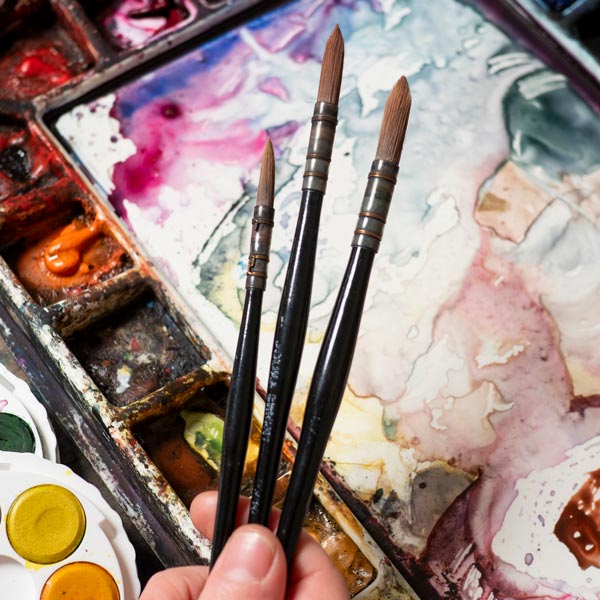
The two brushes I use probably 90% of the time are my Polina Bright synthetic round brushes in sizes 0 and 2. I also brought some mops, a hake, a rigger and a big hog-hair round.
Do I need all of them? Probably not.
Do I feel better knowing they’re there? Absolutely.
If I head out on a dedicated painting mission and need to drastically reduce what I’m carrying, I also have two Princeton Aqua Elite travel brushes. The handle comes off and becomes a cap for the bristles, so they don’t get damaged rattling around in your bag.
They’re brilliant for putting together a tiny watercolour kit when you really do want to travel light.

Gouache
I know from unfortunate experience that one of my most beloved art supplies, Caran d’Ache Neocolor II pastels, does not handle heat well.
They melt surprisingly quickly and, if they’re left in direct sun, can start to crumble.
Knowing we were heading into some seriously hot weather, I needed a backup plan for an opaque medium that would combine nicely with watercolour.
Enter: gouache.
Gouache and I have never really been friends.
I can never seem to get the consistency quite right, and it means managing another palette. But it was the next logical option without carting around a huge tin of pencils alongside my huge tin of pastels.
As luck would have it, I’d been given a beautiful tin of gouache in that glorious Caran d’Ache red. Fifteen colours in one compact tin.
If there was ever a time for gouache and me to get reacquainted, this was it.
My first few dabbles were actually quite pleasurable, and I’ve realised that I need to work outhow I work with gouache, rather than trying to force it to behave like another medium.
It’s just new. And different. And that’s probably a good thing.

Caran d’Ache Neocolor II pastels
Just because they struggle in hot temperatures didn’t mean they weren’t coming along for the ride.
I brought the full set of 84 Caran d’Ache Neocolor II pastels. Yes. All 84.
These are one of my most beloved art supplies. They’re fun on their own, fun with friends, fun mixed with watercolour and fun mixed with just water. The ultimate versatile medium...
As long as it’s below about 30 degrees.
Before we left, I genuinely wondered whether I’d need to keep them in the caravan fridge knowing we’d be travelling through high temperatures for months on end.
Thankfully, that never eventuated. They’ve held up surprisingly well. I tend to get them out in the cool of the morning or work in the shade, as direct sun seems to be the biggest problem.
My two-year-old son Ned also loves Mummy’s enormous collection of colourful crayons. I’ve surrendered to the fact that they may not all survive the trip. We might as well have some fun with them together.

The pencil case of sundries
I’ve had the same pencil case since my uni days. It has lived a long and hard-working life, but somehow it’s still going strong. This is where I keep all the little loose things that would otherwise disappear into the depths of a tote bag:
Fineliners and Sharpies, a pencil sharpener, a handful of Derwent Inktense pencils, a bottle of ox gall liquid, a few spare Neocolors, greylead pencils, a dip pen and various nibs, plus my travel brushes.
The Inktense pencils were originally another possible alternative to gouache. I didn’t end up liking them quite as much for that purpose, but they’re very handy for drawing and doodling.
My unexpected discovery: ox gall
I had seen bottles of ox gall liquid in art stores forever and never actually knew what they were for.
Then, during one of my workshops in Bowen, a student told me they used it regularly in hot weather. It acts as a wetting agent and helps your washes flow more easily across the paper, buying you a little extra working time when everything wants to dry at lightning speed.
Obviously, I had to try it.
I picked some up at the next art store we passed and it has been such a useful addition to my kit. You only need a few drops in your water jar, so a tiny bottle goes a very long way.
Such a great tip if you’re painting somewhere warm.
The travelling ink dilemma
I also picked up a dip pen early in the trip, along with some calligraphy ink. I love the look of dip pen drawings. Unfortunately, I do not love the look of calligraphy ink all through my art kit.
No surprises, it leaked everywhere.
I even had it inside a zip-lock bag and still didn’t have any luck, so the bottle eventually had to go.
The dip pen has stayed. I just need to find an ink that can survive caravan life without requiring 23 layers of protective containment.
So, do I actually need all this stuff?
Probably not.
I could have reduced the number of Neocolors I brought with me. But knowing we were going to travel through so many completely different environments, I felt like I might want to call on colours I wouldn’t usually use at home.
I don’t need 20 brushes. Or do I?
The truth is, when we packed up our lives, I had no idea what creating on the road was actually going to look like.
I wanted enough flexibility and variety to cover plenty of potential bases. Zooming off to the local art store to grab one quick thing isn’t always an option when you’re travelling, and ordering online takes a surprising amount of organisation when you don’t have a fixed address.
So this is where I landed.
Ten years of studio life, condensed into a wheelie toolbox and one very overworked tote bag.
Funnily enough, I haven’t painted nearly as much as I imagined I would.
Where is all that spare time I was dreaming of?
Without a dedicated studio space, it’s a very different game, particularly with my two little boys around. I can’t wander into the studio, leave a half-finished painting on the table and pick it up again later. Everything needs to come out, be used and then be packed away again.
So I just do what I can with the time I have.
And maybe that has been one of the unexpected lessons of taking my art practice on the road.
I don’t need the perfect setup. I don’t need my whole studio around me. I don’t even need hours and hours of uninterrupted time.
I just need enough.
Enough materials to play with. Enough paper to put something down. Enough time to notice where I am and respond to it.
And every time I get the opportunity to pull everything out, sit down and paint, it feels like absolute bliss.
A little note about links: I’ve linked some of the art supplies mentioned above to make them easier to find. A few of these are affiliate links, which means I may receive a small commission if you purchase through them, at no extra cost to you. As always, I only share and recommend materials I genuinely use and enjoy.